

Aiki
|
I spent way over half of my twenty year plus martial journey in the search of technique until I finally realised I had been barking up the wrong tree. And few thought to advise me otherwise. The name of the art is Aikido and, if you think a little, it is aiki that needs to be isolated, defined, sought after, and trained. To do this we specifically have kokyu-ho and kokyu nage and after years of doing it we ought to gain a measure of aiki strength, or kokyu-ryoku. Of course, many do have more than a measure of such strength, yet, it is often more accidental than purposefully striven for. Somehow, in English, the word strength offends the Aikidoka, but there it is, in stark reality, in Japanese - ryoku. Anyway, we first need to develop our aiki strength - but recognise that this is not aiki. At the heart of the problem, however, is just what that strength is in realistic teacher-to-student transmission terms. We are always told to off-balance, to make good technique, to practice smoothly, to relax, to remove tension, to find an easier way to do it all, all the while without explaining the how of it - as though some magical means is supposed to just one day reveal itself. This cannot be right. Part of the problem is in training methods and names, or rather, the lack of them. If you come across something interesting in Aikido, there is likely no name for it thus no means to isolate and quantify it, or worse, remember it. Kokyu-ryoku is the kind of power we generate through extension and moving our bodies efficiently. We then apply that power to uke and control them. It can be very powerful but remains somewhat mechanical. The ultimate in aiki power is that lone finger, quite incomprehensible, that steers uke up and away or down to the floor with delicate precision. A contrasting method is to send uke away or down with such a force that they are momentarily shocked, experiencing sudden fear, again with seemingly little effort. Impossible for the most of us and even for the students of those that can, it is at the very least necessary to travel far and wide to seek and experience it – if only to know the realm of the possible and to keep such in mind as a distant aim. In the meantime, one needs to develop a more practical and achievable definition of what aiki is.
(b) Defining practice
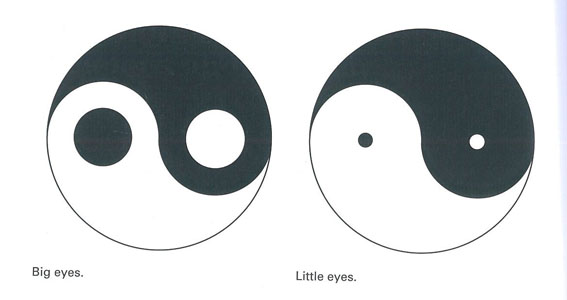
The yin-yang duality of Chinese thought can be applied to the aiki learning approach. The smaller the eyes of the yin-yang circles, the greater the difference between the hard and soft either between styles, or within a style – but even though small, hardness still remains as an intrinsic part of softness and vice-versa. The larger the eyes, the more the two merge into each other, meeting at some happy median. Even within a style there are always those of a slightly harder or softer disposition than others. At one extreme are those who only use solid technique from a strong centre to twirl uke around and down, at the other are those who insist that uke’s determined attack be the sole energy input leading to their demise. In reality, those most like ourselves become our favourite training partners but when dealing with extremes of any kind, it makes sense to bring the majority towards the centre by developing Aikidoka with ‘large eyes.’ But this does not mean that the ‘little eyes’ are wrong – working at the extremes is absolutely necessary, the mistake is to work at only one. |
|
(c) Progressive method There are two common poles from which to start the aiki journey. The first route recommends ‘light-fast’ training. This develops rapid understanding of movement, timing, and co-ordination. The second path is a ‘slow-heavy’ approach through which the student learns to perform basic movements against increasing resistance against many different people. Both routes have validity and head towards the same destination, yet many, most even, never arrive. In the meantime, later adding a component of slow heaviness to the ‘light-fast’ route is not so easy as one has always trained to be light and such seems to run against the 'perceived' aiki grain. Contrasting this, adding speed to the ‘slow-heavy’ approach instils the idea of logical advancement in skill. While in the short term progress seems to be slow, in the long run it leads to a better understanding of the basics; training against measured resistance means that, by necessity, tori has to contact with uke’s centre from the very beginning of their aiki journey. By adding speed later, tori can create and maintain that already learned aiki feeling within more rapid movement. Having trained extensively in both environments and having reflected upon the outcomes in terms of my own training and that of many others I am convinced that natural progression is the logical means: Adding speed to heaviness later on in one’s development is far more beneficial than adding heaviness to speed. The most important fact is that someone who does not have aiki can be taught to recognise it and to develop it and the most efficient means to do so is through solid kokyu-ryoku, kokyu-ho, and kokyu-nage exercises. One first learns to move uke from a position of mechanical strength and over time the aim is to advance by reducing the amount of effort needed, replacing force with technical skill amidst the harmony of fluid movement; one has to develop a composite understanding of co-ordination, space, time, speed, power, and technical skill – all realistic aims in the quest for understanding. True aiki appears when tori demonstrates superb sensitivity in movement, he uses the skills he developed while being uke himself to melt and absorb his opponent's force, merging with uke’s strike or grip and general body movement to the extent that uke actually feels comfortable while beginning to be immobilised or thrown. But contrasting this, it is also necessary to learn how to disrupt and cause disharmony and imbalance in uke, sometimes to the extent that they feel very uncomfortable. With any logical approach, even if aiki were never fully understood, the keen student should still have a good understanding of martial movement resulting in real skill in self-defence. The point here is that achievable aims need to be set, worked on, and overcome. If the only aim is one-finger magical Aikido there will be no practical means to achieve it. At each level of development one’s understanding of aiki will necessarily change; there is no singular answer as to what it is in the midst of process, only that one should seek, all the while keeping an eye on that elusive goal while never straying too far from reality.
(d) Other aiki Definitions of aiki are sometimes broadened to include any means whereby uke is manipulated, controlled or toppled with minimal effort. For example, any efficient means of taking uke’s balance to effect an immobilisation or projection can be regarded as being in tune with uke and as such is not limited only to Aikido. To trip someone up requires perfect timing and co-ordination, and the result is an unbalanced uke who is momentarily wide open for a technique. A boxer who can avoid all attacks with ease and hit his opponent at will is demonstrating a kind of aiki. The magician who misleads his subjects, directing their attention at will, performs an excellent composite of mental and physical skills in the moment. The husband / wife, worker / boss, and man / dog that accurately gauge each other’s minds or feelings with careful observation are somehow in tune with each other and such skill can be an example of aiki. Extending the argument further, any craftsman who is master of his trade and can do some complicated looking task with nonchalant effort is also demonstrating a form of aiki between himself and the object he is working on. Some people like to say that such high degrees of nonchalant skill in particular fields of skill are demonstrations of a kind of aiki. But in Aikido, the aiki we seek is quite different. What we seek is to control our partner through fine sleight of hand, controlling uke's energy and balance to produce waza. All our previous training - strength, speed, timing - provide and important basis but it does not automatically result in aiki.
(e) How to find centre Everyone struggles with this for ages - it is impossible to understand what aiki is (or my interpretation of it) without understanding centre. I tried listening to everyone for years but it simply does not sink in until you have been through all the exercises under the sun, and then some. However, what is abundantly clear is that many of those attempting to explain it either can do it but can't explain it, or can't do it so can't explain it. The only way forward then is to search for yourself. I don't know if I am the former or the latter but I will try to explain how to learn it in a more efficient way than 'they' gave me. First: practice pushing people around (either tegatana to tegatana; or try tegatana against uke's chest/shoulders/body). Move back and forth up and down the mat. Then, have the person being pushed do a little tai-sabaki to make it harder for tori to push directly at uke. When pushing uke directly, tori feels he can simply, push uke; when uke turns, tori has to search for uke - then find him - to make direct contact again to push him. This is 'making contact' with uke and the easiest way is to simply push him straight. When you get better, you can catch him earlier when he turns and maintain the pressure. In this way, you begin to find and feel uke's centre, i.e., where he is. Second: once you get a good feel for uke's centre you can begin to try to feel that you push him with your body through your extended arms. Then try it from your feet, through your body, and through your arms. This will take awhile but it is easier to find your own centre after you find uke's centre. What this means is, if you are a beginner, it is really a waste of time to do lots of solo exercises to try and find your centre - it will just make no sense at all. Worse still are exercises where you just stand there waving your arms about - dreaming for some kind of elusive enlightenment. It might work if you are determined, but it didn't work for me. Once you get the idea of pushing uke with your body through your arms, try doing ikkyo in the same way, and so on. Third: join two swords together at the hilt and push each other up and down the mat (strength is fine at this point - sometimes, the more the better). When joined at the hilt it is easy. Next, move slightly away from the hilt and you will find it hard to push with strength while maintaining sword contact. Next move further down the sword. Finally, try with the swords say four inches apart - advance and retreat, 'pushing' uke. This will help you understand what people mean when they say things like 'push from the centre, keep centre, control his centre'. It is actually pretty easy - the problem is in the words - when people say 'keep centre' the beginner has no clue what they are talking about and might even be doing it right already without even knowing it. Fourth: I came up with this from wrestling, where you get a point if you push your opponent out of the ring, which means, you try to push him out and he tries to not-be-pushed-out, and it provides a good exercise. So, for the exercise - open your arms and keep uke inside-ish. Pick a spot on the edge of the mat and try to direct uke towards it. Uke tries to get out of your arms (not too fast as it is too easy to escape - the purpose is to learn centre). To escape uke has to move backwards and sideways but it is not too difficult to track him to your spot since you are only moving forwards. As uke moves say left, so you move left and refocus him on that original spot and push. As he moves right do likewise and you shuffle/guide him to the edge. There is no need to wrestle - this exercise simply allows you to line your centre up with uke's and the spot at the edge - and push, and the result is you become a little more aware of what 'keep centre' means. Here, you are focusing on irimi, there is no tenkan in the mind of tori. On the other hand, all uke can think of is tenkan. What I also find from this is that good irimi can track and follow tenkan (what I mean is, once you have him on the run, you have him). It is also fun to push a bit harder. Fifth, being good at ukemi is very important. Ukemi is Aikido's main advantage in pursuit of aiki. With ukemi we learn to respond to tori either lightly or heavily, depending upon how we wish to train in a particular moment. Both the light and the heavy are important. But being light is more important. The more responsive we become, the better a feel we get for our partner's energy/intention and the better we become placed to deal with it should we wish to 'turn the advantage around' and take out tori with subtle movement = moving towards understanding of aiki. We need more and more of this training/thinking in order to move in this direction. Just doing is not enough ; one has to think it too. The mind directs the body to do its will, so to speak.
(f) Encompass all Aiki can not be found by practising external technique alone. In the broad sense, one has to collect together and develop all the principles of Aikido. Aiki, in essence, is the flow of energy, thus tori has to learn to flow with, and to take control of, uke’s energy. And the purpose of doing this is to defeat uke in a martial sense – it is not a dance, nor is it peaceful. Aikido uses the tegatana and as such, various hand positions become very important. However, while the tegatana is a useful tool for learning to understand aiki, it is not the be all and end all of technique. Those who understand aiki do not need a strong tegatana to demonstrate it. The most common method of learning aiki is in terms of physical hand-to-hand contact, but this is only one of several means available to redirect uke’s energy; patience brings solution, calmness dissipates anger, confidence instils doubt, kiai shocks, atemi, real or feint, causes reaction – all need consideration. Regardless of the Way one is following, the key to arriving at the destination is planning one’s own journey. One needs to know where one is at, where one is going, what one needs to continue, and how to get it. It is not good enough to rely on others. It is important to realise that there are no shortcuts, no magic grips or hand positions, and no secret escapes; the only real way is through consistent hard training while consciously incorporating and unifying all the aspects of Aikido over an extended period of time. A practical approach In Aikido, the system is such that if you find a teacher who can do things to you, as uke, it is your responsibility to learn and remember with little or no useful explanation. Such is often your total 'direct' experience yet in fact it is quite secondary or rather, 'indirect'. It can only become direct when you try to do what your teacher did back on him, or on others. And it only becomes direct if you get it right. If you cannot get it right, it cannot count as direct experience in any way whatsoever. Accordingly, if you have an inkling of it, it is your task to chase it, to develop it, and to rediscover it. And if you have it, it is your responsibility to come up with the means to pass it on. I say 'come up with' because there are no widely recognised or named means. I will contribute a couple of 'names' or 'ideas' to the discussion: The ball: If you press on a ball on the floor, the ball presses back
and resumes its shape once you let go. Newton would agree that this is quite a
natural phenomenon. Thus, if you press uke down and release the pressure,
uke should get up - if the attacking spirit is genuine uke will
get up naturally, if not genuine, uke thinks 'I am supposed to get up
now,' and gets up, but is quite late. The genuine attacking spirit in uke
might also be likened to pushing a ball under water - if you do not focus dead
centre, the ball slips sideways and pops up instantly, or if you like, honestly.
Aiki-strength While the objective always seems to be to do everything gently, I assert that pressing strongly allows a better development of the principle and thus we should seek to find grace from within developed strength. Accordingly, the strength of aiki, or should I say, kokyu-ryoku, demonstrated here is directly proportional to how hard you can say, press and rub a ball against a wall while keeping balance and posture. Thus, you need to train to make it stronger, stronger, stronger, not weaker, as is often heard. And remember - the aiki strength here I keep referring to is not standard muscular strength, but kokyu-ryoku. Also, pressing is not pushing. Aiki concepts I already mentioned pressing the ball above. Sometimes, I like to think of compressing a spring between my hands outstretched in a circle. Sometimes, it is a hard spring, sometimes a soft slinky kind of spring. The spring never fights, it just maintains a certain tension and sits and waits. It never becomes stiff and always remains free to move/react at the slightest change. By doing this, or thinking about doing this, I am training myself to be like the spring. Sometimes I have strong tension, sometimes slinky tension. The aim is to avoid stiffness while developing power and technique. It is important to develop both a strong and slinky spring approach and thus to lengthen your line, so to speak; your aim should be to develop your strong spring at one end of the spectrum and the slinky to zero spring at the other, with the ability to instantly alter the power of the spring at any moment without becoming tense. Thus, when you deal with your partner, you become the spring, and can react to whatever he does as he does it in the moment without becoming tense. People with good ukemi skills can do this, and becoming good at ukemi is one way to to get half way there. But our ultimate aim is not to be good at ukemi but rather to use it when tori. Our springiness becomes like the antennae of an insect that can feel what uke's body is doing and even what uke's mind is thinking. It opens the door to taking balance, the opportunity to apply our technique, which should suddnely appear due to training, without conscious thought, using good kokyu-ryoku power (soft or hard). This cannot easily be learned with just a partner. You need to go home and practise by yourself. Then go back and try it on your partner. And repeat. * If you have been training a few years and can't figure it out - come find me and I will show you what I have found. ----------------- It might seem that the wheel belongs in the attack section and the ball in the ukemi section, or even vice-versa. Perhaps the idea of the spring should be in the generating power section, or the resistance section. That may be, but in order to train with an aiki purpose, all have to be ultimately brought together under the roof of aiki. My thinking, which is pervasive in every section, is that Aikido should be viewed as The Way of Aiki.
* A straightforward progressive learning process is outlined at the end of the chapter on Strategy. |