Generating Power
|
It may be that the race is not always to the swift, nor the battle to the strong - but that is the way to bet. Damon Runyon
The potential energy of movement is that latent energy one has developed and stored in the body though training. It exists, waiting to be used. Once you begin to move, kinetic energy is created, and the greater the mass that moves, and the greater the speed with which it moves, the more powerful will be that energy. The equation KE=½MV² shows us that the speed component is of far more importance than the mass, meaning, that with training, a smaller, yet faster person has every chance of out performing a heavier, slower one. Learning to generate power does not mean performing hundreds of sit-ups, squats, or press-ups. Outlined below are methods whereby one can develop and maintain an aiki kind of power in an aiki context – otherwise known as kokyu-ryoku. For the weak, it may be that an external physical training program could be useful. If so, one has to be careful not to develop in an unbalanced way, or to train in such a way that one's aiki development is compromised. What is power?The simplest understanding of power is the physical strength you gain from going to a gym. You press a weight and over time that single muscle becomes stronger. But this is not so useful for us. What we need is coordinated power. That is, we need to train ourselves to develop several muscles or groups of muscles over the whole body together to achieve what we want. Then, synchronising our movement with our breathing develops yet more power. And finally, once we allow our skeletal structure to take the place of muscle, it feels as though we use less effort. Once we get this basic understanding we can then start to root our power from the earth, from the ground, through our feet, up through our legs and bodies and out through our hands and into our partner. You cannot learn this in a weights gym pressing one weight at a time. Next you need to start to fit this to your own understanding of your own martial system and try to make it work for you. The aim is to generate power and to realise that, hey - more is good -and it works through good structure. And finally, you need to combine with your partner's movement in such a way that you can readily apply your power at will so that you can absolutely destroy them, and yet, if you get this far you will find that, mysteriously, you barely need any power at all, and, nor does your ego need to destroy them. Note: Some of the following ideas could have been put in the Principles section. |
(a) Kokyu-ryoku
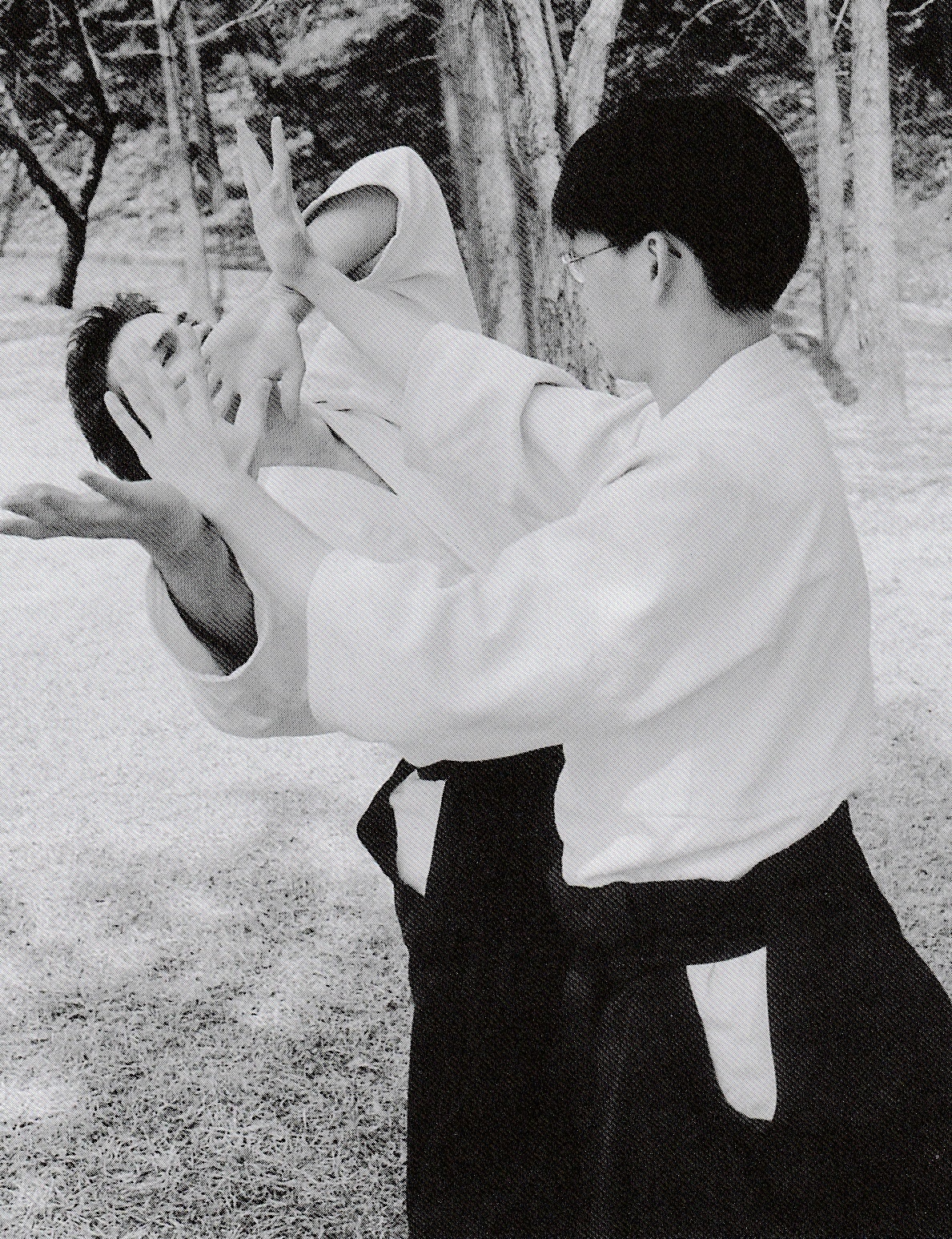 |
Kokyu-ryoku is the strength behind solid aiki. It translates literally as breath power but is better interpreted as being the clever co-ordination of breath and efficient body movement. Beginners often use brute strength to make technique but in time learn to use their bodies more efficiently. But that does not mean less strength – continued practice makes one stronger so that more kokyu-ryoku is available, yet increased skill means that less is used. Those who can do solid kokyu-nage against madly resisting ukes may be said to have good kokyu-ryoku. The whole point of it is to transfer this body-movement knowledge into ordinary Aikido techniques. If this can be done well, good, solid Aikido is the result. Most practitioners try to develop kokyu-ryoku with kokyu-ho type exercises. |
| Tori extends and moves well into uke’s space. |
|
To develop powerful kokyu-ryoku, a resisting uke is your best friend. As uke, one should learn to hold strongly yet without becoming too stiff or rigid; as tori one has to be careful not to become infected with uke’s apparent or real stiffness. The whole point is to be able to do it with seemingly little effort but paradoxically one becomes quite strong in the process. One’s kokyu-ryoku must be maintained at a reasonable level as the apparent lightness of Aikido is built on such power.
(b) Body movement As a body art, Aikido has the potential to develop a lot of power. When moving from left to right, forwards and backwards, or diagonally, one's bodyweight can be used to draw uke back and/or around centripetally, or to push them forwards and/or out centrifugally. These movements can be combined with upwards or downwards forces that further aid in causing uke to lose their centre of balance. All these movements are possible and if one trains with them in mind, the power within one's technique can be developed rapidly. To develop this power, first one needs to get one's posture and co-ordination sorted out. To start, one can simply grasp a light uke's sleeve and practice moving in the eight directions of avoidance, gently taking uke along for the ride. It is not wise to do this with power until the co-ordination is well established. Light practice is far better for developing co-ordination. Once the co-ordination is apparent, one can begin to practice with an uke who gives a heavier energy. Uke should not resist or struggle, they should just feel a little heavier. Once one has developed the ability to use one's body to develop even a modicum of power, appropriate care becomes necessary when applying ordinary techniques.
(c) Moving from the centre All movement in Aikido begins in one's centre, so they say. Being a body art, the body moves first, the feet and hands follow. Personally, I have gone through changes and now like to feel the power originating in my feet emanating the earth. Aikido is a body art because it is based on movements of the Japanese sword. In comparison, the movement in rapier fencing originates in the hand; the body and feet follow-up. The difference lies in a combination of two factors - weight, and killing method. While the Japanese sword is a heavier cutting weapon, the rapier is a lighter thrusting one. Although a Japanese sword is capable of the thrust, it is designed to cut strongly using both hands, but to do so requires more strength, thereby necessitating the need for the body to be behind the cut. The rapier, being light, is designed to be thrust with just one hand, and as the hand can move quicker than the body, that is where the movement originates, and the body follows. Wrestling and boxing also differ in a similar way. A wrestler moves from his feet and up through his centre, a boxer seemingly leads with the hands, and the good boxer times his short body movement to 'arrive' at the same time as his long reach. One cannot say that either is the better, all one can do is acknowledge the differences and respond accordingly when training. Knowing how your opponent moves ought to guide your training - knowledge is power. One method to develop a feel for one's centre is for tori and uke to push each other back and forth using their tegatana. Another method is for them both to place a jo down at their centres, pushing back and forth across the tatami. Increasing the resistance to the point that it just becomes a little difficult will help develop a feeling of moving from the centre and increase one's ability at pushing from it. To push uke efficiently, drop a little lower and push up along the jo. For self-practice, try making very short three-inch Sumo style ayumi-ashi steps and twisting the hips in co-ordination. Adding a modicum of power to the hip turn will, after time, create a direct link between the imaginary movement practised by the self and that done with a partner. Practising this same powerful walking movement while using the bokken or jo will aid in understanding the links between these seemingly separate arts. In Judo, one trick to conserve energy is to push or drag uke around using their grip upon you. In Aikido grabbing attacks the feeling is the same. For example, from an ushiro ryokata-dori attack, tori performs taisabaki in such a way that uke is carried around by the transfer of momentum from tori to uke. In fact, twisting back and forth with uke clinging on behind is great practice to develop this kind of power and the principle learned can be used in many techniques. It can also be practised while raising the bokken, real or imaginary, in the hasso style, first to the left, then to the right, and so on.
(d) Torifune Torifune is an excellent method of developing power in the forward and rear directions. Standing in a half horse-stance with feet straight ahead, moving from left to right gives a lateral version of torifune that is indispensable for developing power when moving to the left or right. Stepping diagonally one has the choice between the more forward torifune, or the more lateral horse-stance movement. When moving back and forth in torifune, or from side to side in a horse stance, it makes sense to keep the feet at such a distance that it is easy to transfer 100% of the weight from one to the other with ease. Although wide stances are good for flexibility training, if the feet are too far apart in Aikido exercises, rapid movement becomes awkward. One needs to be able to push or draw with full power and be able to move around at the same time. The feeling in the feet should be one of grabbing the tatami with the toes. |
(e) Unbendable arm
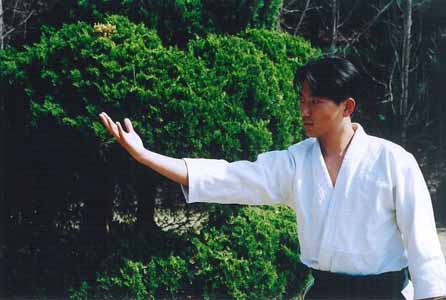 |
The principle of the unbendable arm is a key element in Aikido training. Although often viewed as being nothing but a cheap trick, the real trick in fact, is to use the principle in one's techniques. An almost extended arm is very powerful; keeping it extended will aid in directing uke to the ground. |
|
Extension makes your arm unbendable.
|
|
|
When teaching how to make an unbendable arm students fall into two categories; those who can do it, and those who can not. Those who can just do it immediately. Those who cannot might struggle for years before it slowly clicks. Therefore, it does not seem to be something that can be easily taught - we just have to figure it out for ourselves. However, one trick that might help is to get into a press-up position with arms slightly curved, not locked out. Work on the feel. 'Remember' the way the muscles in the arms 'are' so that when standing up that same feeling can be replicated. When the arm is 'energised' it becomes unbendable. It can not be easily bent, nor easily straightened. This of course needs to be taken into account when performing techniques, since both tori and uke are likely to be of an unbendable aiki nature - one has to find a way around it so rather than bend, one leads. In the same way as the unbendable arm, when one ‘energises’ the stomach or hip area, the region between the lower and upper body becomes unbendable. If one can 'energise' the link between the arm and the hand, i.e. the wrist, then it too will become unbendable, meaning, it will be difficult for one's wrist to be twisted. Finally, when practising counters, maintaining a 'flexible unbendability' will help in preventing one's partner from making the technique, and enable smooth transition to the counter.
|
|
(f) Heaviness
|
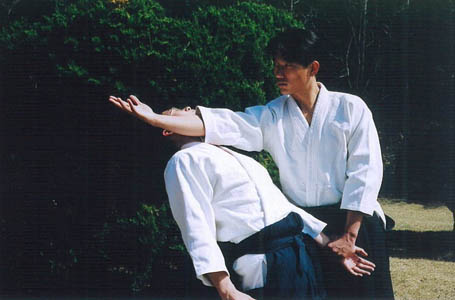
Power in Aikido comes from having heavy arms. In kokyu-ho we often use the palm-up heavy arm, in irimi-nage we have a thumb-down heavy arm. There are four types that need developing, palm-up, thumb-up, palm-down, and thumb-down. Here, the arms are extended in four different forms, and since all of these forms are extant in Aikido techniques, one ought to develop a heavy arm for each one. |
 |
|
Heavy
arm at work.
|
|
|
Also, if there is a heavy arm, so must there be a heavy leg, and so must there be a heavy body. For example, in Judo, the proficient groundwork technician has mastered the art of the heavy body. Barely trying, they melt into and crush their opponent to the extent that they cannot move, or in some cases, even breathe. In Aikido, lowering one's centre while performing critical parts of techniques will help develop a heavier body. (g) Extended arms The idea of extending the arms is pretty similar to that of the unbendable arm but far easier to put into practice. Here, forget about the arm being unbendable. Instead, one concentrates on reaching, extending, as in trying to touch the ceiling, or a distant window. First, practise extending the arms up towards the ceiling, out toward the front or side, and down to the floor as strongly as possible. Next, remember the feeling in the arms while trying a few techniques. Finally, try again using less energy. Starting with a lot of energy and slowly reducing it to the amount necessary to perform the technique offers a means to develop the skill. This feeling of extension can also be used to hone one’s strikes. Extension exercises can be done statically or dynamically. Statical extension is as described above, but sometimes, what can happen is your shoulder pops up without you realising it, so, analyse your self as you do it. Dynamic extension means doing the same thing while moving. The easiest way to practise is to slowly cut up as though holding a sword or doing an imaginary kokyu-nage technique. Focus on pushing your shoulder into its socket as you push your elbow forwards. The elbow pushes the hand, and the hand pushes the fingers, which are extended. It is all done with light extenstion. Now, keep doing it and try to synchronize it while moving your weight left to right on your feet so that any power generated is sourced from the ground, through the hips and up to your arms. Next, while moving, try to extend all your muscles, joints, bones together. Extend everything, but lighlty. Don't hyper-extend joints to their limit, in fact, don't lock any of your joints out while doing this. This is all done lightly, contrasting that of what I call 'dynamic tension', below. |
|
(h) Tension
 |
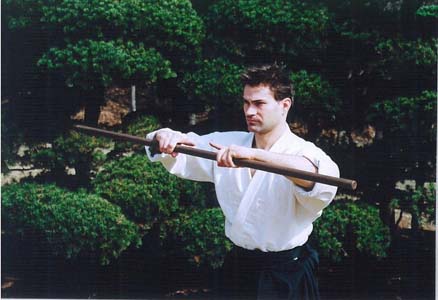 |
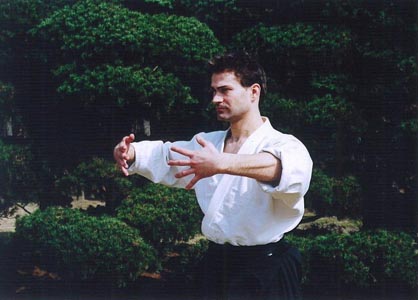
| Maintaining a static position develops natural tension. | Pressing the Jo to develop static tension - it's harder! |
|
Tension exercises can be divided into dynamic, static, and natural. Dynamic tension exercises are where one strains the muscles to their fullest extent while moving slowly from position to position as in say, a Kung Fu pattern. The key is to maintain as much tension as possible and the benefit is that it combines an element of martial co-ordination with strength exercises. It also programs your muscle memory to quickly remember posture positions - or what you have learned. It is important to get it right as you body will remember what you do. If you do it wrong, your body will remember the 'wrong. Static tension exercises are performed without moving. One simply maintains a certain posture for anything from one to five minutes or more. Such exercises are static, but natural in the sense that no tension is demanded of the student, yet, simply holding a position for sustained periods can be very strenuous indeed and thus tension develops naturally as time passes. Because it is so hard to do, your body, while stressed, will naturally adjust itself to find the easiest way to do it. Natural tension exercises can be developed by slowly moving through your techniques on your own, a little or maybe a lot like Tai Chi. The slow and the careful is preferred. You do not move around with floppy arms or floppy anything. When you raise your arms, they extend, for example. As you move from one position to another you strive to maintain balance and general awareness. Again, you must strive for perfection as what you do will be remembered by your body and the next time you train with someone it is what you will do. With no resistance (you are doing it solo, remember) your body can develop this natural extension. For this, rather than Tai Chi, I prefer to think of the tension in a tennis player's body is moving around, natural, relaxed, yet coiled spring-like, ever ready and totally alert to receive a fast ball. Positions adopted typically resemble certain martial stances and these dynamic, static, and natural tension exercises train muscle groups to reform themselves to the extent that one begins to feel more comfortable performing these postures or patterns. One is not better than the other - all are useful. Nor is their any preferred order. While not of Aikido in origin, there can be benefits from these types of training.
(i) Turning (i) Turning movements, or taisabaki, are done in two distinguishing ways. One school of thought sweeps the rear leg around in a large arc, in the other the rear foot steps straight back. Sweeping the leg around in a large arc adds power to the technique in a broad way and is useful for trips and sweeps. Stepping back is faster and focuses on the pivot. When performing a taisabaki movement such as tenkan it is often to avoid an attack but with a little thought and practice, a lot of power can be generated by this exercise. By combining the straight and lateral torifunis we can make a kind of circular one whereby taisabaki and torifune are combined, which becomes more effective in breaking balance the closer one's centre gets to the target point on uke's body, say the head as in irimi-nage, the elbow as in juji-nage, or the wrist as in kote-gaeshi. Watching powerful performers of these techniques one will notice two types. The first type moves in behind uke and spins round quickly maintaining a forward stance, sometimes turning all the way around dropping to one knee, similar to a torifune type movement with the inclusion of lowering their centre deeply. The second type spins in the same way but uses a more lateral horse-stance type of movement, again dropping their centre, but more slightly. Both of these movements draw uke in using centripetal force. Once tori begins to make technique, uke is typically thrown off with centrifugal force. Sometimes though, uke is drawn in so strongly that the centripetal force alone is enough to take them to the floor. Naturally, the wise student ought to think hard of exercises that could develop their centripetal or centrifugal power. One idea is to imagine tight elastic wrapping around the waist as one turns. Here, one can turn with dynamic power, even when training by oneself. Turning (ii) Another contrasting idea is that when you turn, you apply no power at all. Basically, with this idea, you only apply power when moving weight from one foot to the other, like when moving in irimi. The turn tori makes simply receives or slightly redirects uke's attack while at the same exact time, lines tori's centre up to uke's. Personally, I have become a big fan of this idea. Removing any idea of power/tension for one's turn allows one's body to move freely into a position from which one can immediately apply linear power. In this sense, this method of turning neutralises uke's attack and might be said to have unlimited power of a more aiki nature. I call it my Taichi approach to doing Aikido. (j) Yonkyo grip Aikidoka usually develop a powerful grip. To make the grip more uniform, to make it a principle, it is useful to think of yonkyo. In yonkyo one presses the inner knuckle of the index finger against uke's arm causing pain. Holding firmly with the lower fingers, the index finger is free to point. It is not easy to perform well and needs constant development. Often, people with small bony hands are better at it than those of a more bear-like disposition. In order to develop the yonkyo grip it is a good idea to make all of one's grips in the yonkyo fashion. For instance, use a yonkyo grip when holding katate-dori as uke, when making ikkyo as tori, when holding the bokken or jo, and even when holding the hand rail while standing on a train. In particular, I think it is quite enlightening to use the yonkyo grip while making techniques. It does not have to cause any pain, it just helps make good technique. It is a solid principle. It stands to reason then that tori learn to avoid the power of uke's yonkyo grip. |
|
(k) Hasso grip
 |
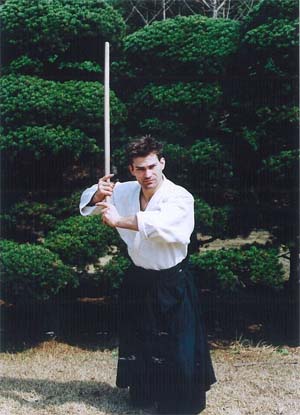 |
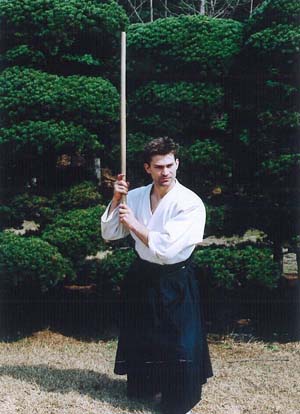
| Hasso posture, elbows down. | Hasso posture, elbows extended. |
|
There are two ways to hold the sword in hasso posture. One method, the most common, is to stand in hasso posture with left foot forward, sword hilt at the shoulder, sword pointing up, with the elbows down, half relaxed. Under consideration here is the position of the elbows. In this case it allows for relaxed, fast cutting and no one would deny it is conductive to good aiki training. The second method is to stand in the same hasso position but with the elbows splayed up and outwards horizontally, infused with energy. Here, it is useful to stretch the sword hilt somewhat between the two hands while holding it, thereby adding to that splayed out feeling. Also, when cutting, try to maintain that splayed out feeling in the arms even though, by necessity, they come together somewhat as the sword descends. But even at the bottom of the cut, they remain slightly splayed out, still stretching the hilt. This style of grip can be used for shomen-uchi, yokomen-uchi and tsuki and offers insight into swordwork that leads directly to empty hand techniques. To explain this in more detail, try this exercise. Have two people try to pull your arms apart from the elbows, one on either side, while touching your fingers together about one foot distance from the centre of your chest. It is quite easy to stop them pulling your arms apart, in fact, if you let them pull your arms apart a little, you can easily draw them back to the centre. It is a very efficient position. Now, as they continue to pull, try to remember the feeling in your chest / abdomen area and which muscles are being energised. Think of it as being an extension of the unbendable arm idea. Next, have them to let go but maintain the feeling and pick up the sword taking hasso posture. Now it will feel like a very powerful posture. Finally, put down the sword, and try irimi-nage keeping that same energy in your arms and chest. Try a few different techniques and you might have another of those mini-enlightenments. This does not mean that one abandons a previous approach, merely, that one considers the new.
|
(l) Hitting & cutting
 |
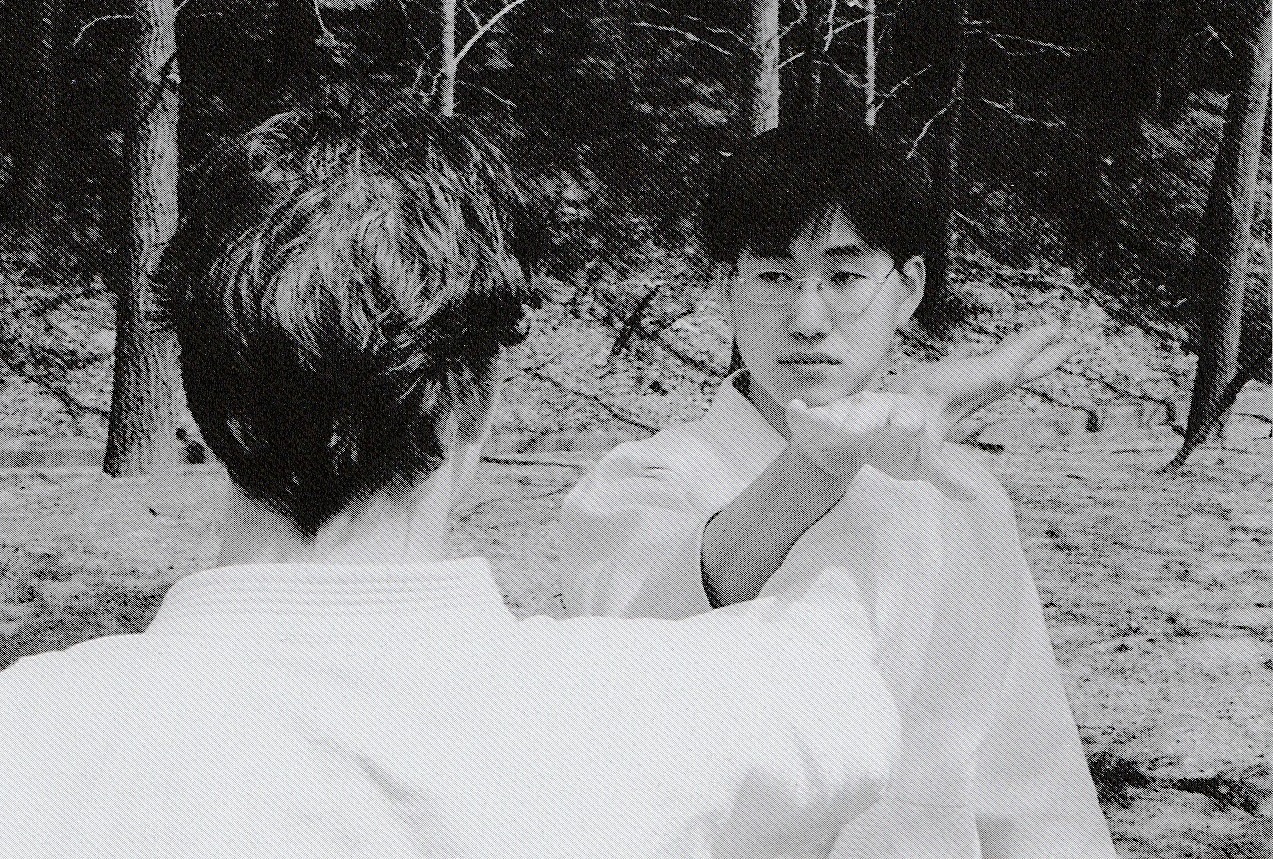 |
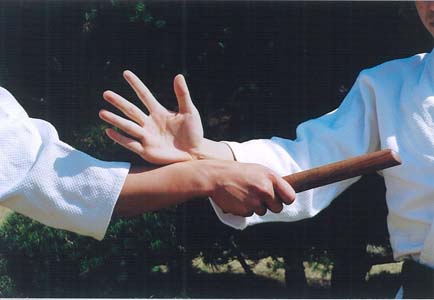
| Tori can meet, hit, cut, or push. | Ai-hanmi - striking the attacking arm. |
|
Aikidoka often make a cutting movement with their hand, or tegatana (hand-sword), during techniques. It can be a soft meeting of arms, it can be a hit, and it can be a cut. By far the most common is the soft meeting of arms in harmony. By hitting I mean just that, attacking their weapon (arm) by hitting it. If uke had a knife, then the shock or pain of the strike might cause it to be dropped. By cutting is meant adding considerable weight and following through, or pressing. One could also hit and then cut. Now this might sound odd, but when break-falling in Aikido, every time one whacks the mat hard with an arm one is potentially practising a hit. Accordingly, hitting the mat hard after a breakfall can be useful. To develop this as an independent skill or to raise awareness of its potential, from standing drop to one knee and whack the mat with your forearm. After doing this for about a minute, try doing irimi-nage. It is enlightening; one will walk the streets in quiet confidence.
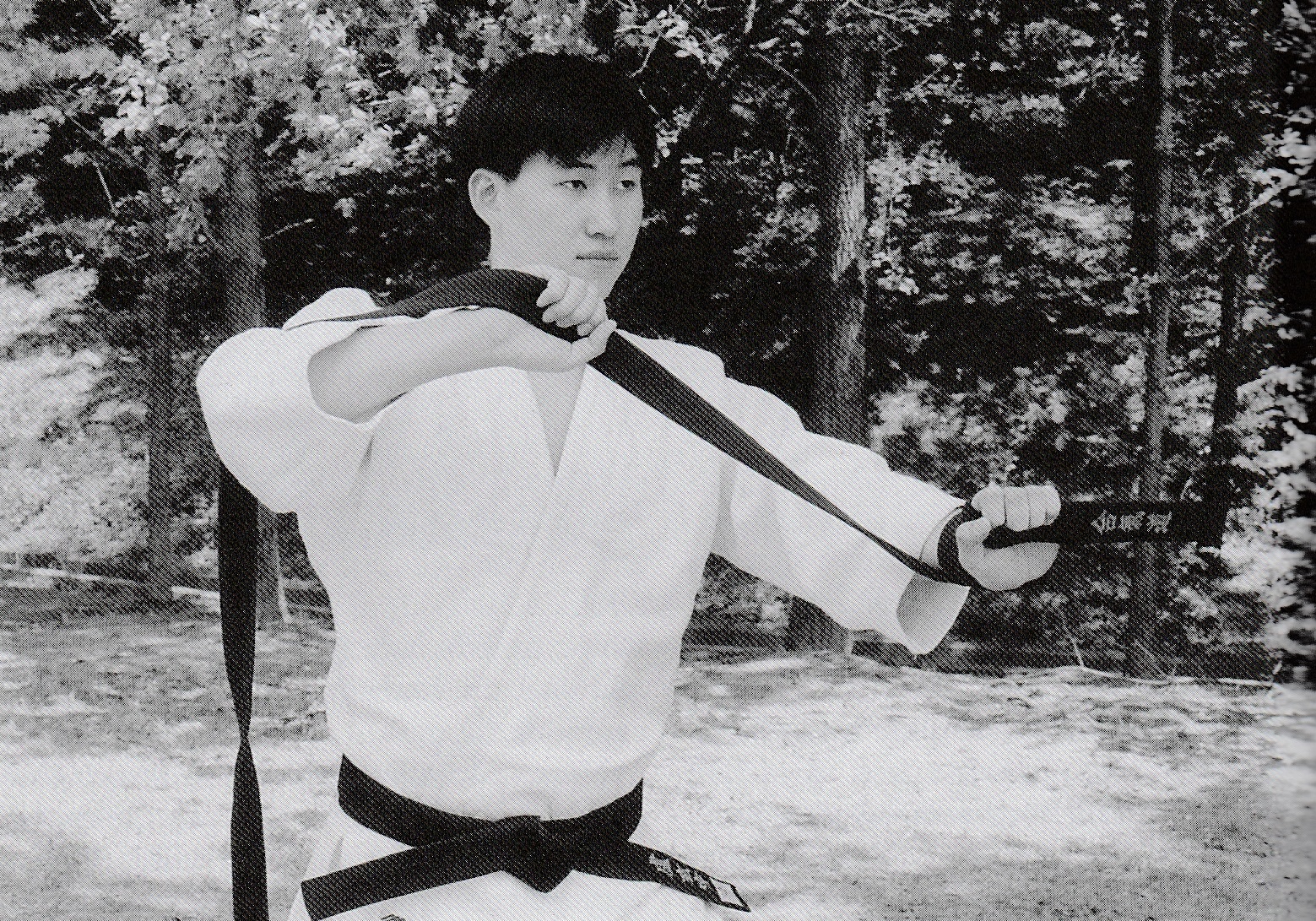
(m) Winding the bobbin
|
||||||
(n) Jerking
|
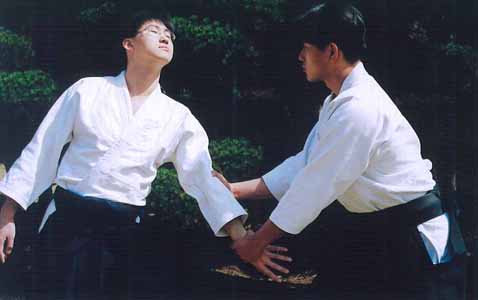
A sharp jerk can disorient uke. |
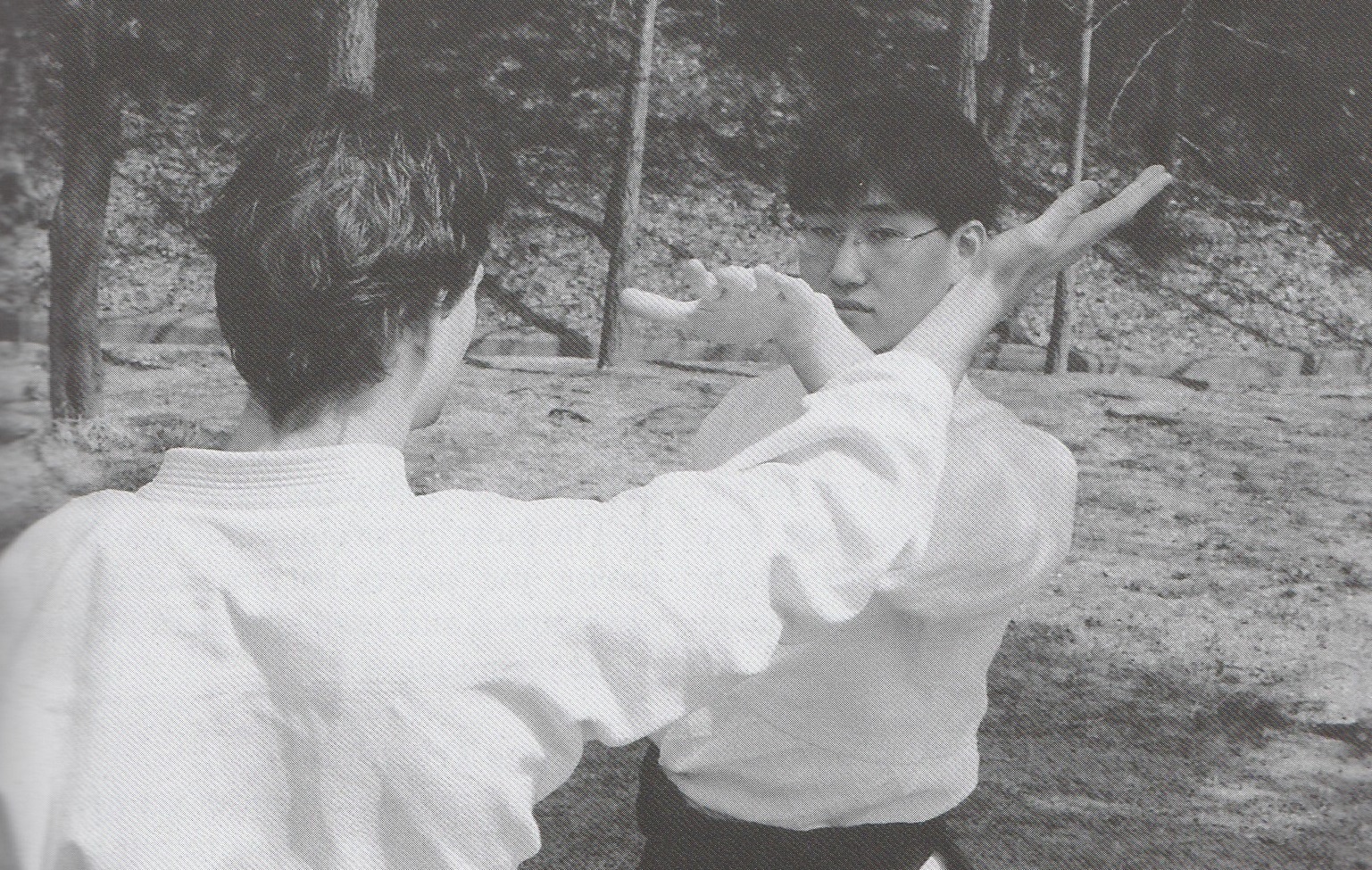 |
A sharp parry. |
|
Not common in Aikido is the jerk. Jerks can be short sharp pulls or short sharp pushes. Such movements are what can turn tame Aikido into brutal self-defence. To develop the power in one's jerking movement one needs a very agreeable uke. When jerking the arm downwards it is important that uke know in advance to stiffen up their neck muscles slightly to avoid whiplash. A little practice will establish a powerful jerk, and that power will increase four-fold if one's body weight is behind it, especially in combination with the stomach crunch explained below. Of significance is the fact that a sharp jerk can disorient an aggressor quite severely allowing one to either follow up with another technique, or get away. Another use of a jerking motion is in parrying or blocking an attack. As an attack comes, say a yokomen-uchi, one's arm meets it in the ordinary way but at the point of contact a short, sharp strike is delivered with the side of one's forearm. This can be likened to hitting or cutting the arm with a chopping knife. From a distance it looks like a Karate block but is in fact a hit that fits the movement in space and time. This 'counter strike' can blend with the attack, it can be either a defensive or attacking parry, or it can simply be an effective straight block. A small jerking movement can also be used to push uke away to great effect. After a lot of practice the rough edges of a jerk can be smoothed out until it looks more like a strong pull or push.
(o) Crunching Developing strong stomach muscles allows the erect body to crunch downwards slightly with great force. With uke in one's grasp, forcefully bending down slightly, or crunching, a strong off-balancing movement can be made. Here, the stomach muscles are being used to draw uke forward, not quite Aikido in style, but very effective in result. Likewise, straightening up after a crunch offers more power for use in the technique. If one crunches slightly to the left or right then it has the effect of drawing uke around centripetally. This is not quite the same as lowering one's centre, which can achieve the same result. Lowering one's centre while holding uke has the effect of adding your bodyweight to the point of contact, and if that point of contact is within a technique, such as nikyo, or strikes a pressure point, so much the better. Of course, lowering one's centre and crunching can be done at the same time. (p) Standing up - making posture If you slacken your posture slightly and then straighten it upwards, it has the potential to generate a lot of power. Or, try raising and cutting with a sword. Concentrate on the raising up as high as possible and think: 'upwards'. This is easily seen in irimi-nage. A lot of people generate power this way without realising it. If you realise it, then you will have more power and will be able to develop it. I like to think about it as an 'extended body' in a similar way to how we view the 'extended arm'. (q) Jumping Often seen in Ki Aikido classes, jumping can be analysed in two parts. First, by jumping, tori can move in quickly behind uke for tenkan. Here, the increased momentum given by the speed of the jump is used to draw uke around using centripetal force. Second, since what goes up must come down, tori can also develop extra power to the technique by dropping heavily. The most important point in jumping is timing the movement to coincide with uke's attack and matching it to an appropriate technique.
(r) Vigorous training If one trains to develop power yet never uses it, how is one to know how to put it in the technique? One needs to train hard. Vigorous training means uke gets up and attacks immediately, repeatedly. When one has trained hard for a period of time, it is possible to train lightly yet with intensity. Uke also needs to strike strongly, just enough to push tori. When gripping, uke should grip hard enough to give tori something to work with to overcome. Sometimes tori may fail to do the technique. That gives them something to work on. In this way, one will be able to train ever harder and develop real skill. It is not easy to do it the other way around. For example, if one only trained lightly and uke just flew, one would lack the knowledge of knowing the difference between correct and incorrect movement. Having trained hard against a measure of resistance one knows where to move, and training lightly can then, and only then, be done correctly. Of course, it is also essential to train lightly as it encourages speed and aids co-ordination, timing, balance, and centre. Uke learns how to become fast yet heavy at the same time; tori learns how to deal with it. The goal to keep in mind is to mix the two extremes, to be able to deal with a heavy, uncooperative uke in a light manner. It goes without saying that this be done in a friendly way and not become overly competitive.
(s) Centrifugal and centripetal force Recognition and usage of centripetal and centrifugal forces can and should be developed. If you spin a conker around your head on a piece of string the conker stays in its orbit because the centripetal and centrifugal forces equalise each other. If the string wraps around your finger as the conker spins the conker gets closer to the centre. If you let go of the string, the conker flies off at a tangent. Likewise, tori can draw uke in in a spiral, like the conker, and then let uke fly off - with a little extra power added for good measure. Centripetal force can be used when you enter tenkan and draw uke in. If you are crafty, you may also be able to use centripetal force in your irimi techniques. Use uke's initial movement, and then add some while drawing in. Obviously, the more you can add the more powerful your technique becomes. Too much too soon and uke might even fall down before the technique is finished. Centrifugal force is that which is used to spit uke off. Likewise, the more you can add, the more powerful your technique becomes. You can, and should, develop such power. But use it carefully!
(t) Spirals The circles people talk about in Aikido are really spirals and there are two types. The decreasing spiral is one that gets smaller and smaller as you say, move forward. Examples are in every technique - in ikkyo you start with a largish circle and as you move through it the circle gets smaller. This is typically the 'direct' way of doing it, reversing uke's energy back at him. If you concentrate on developing your spiral, then you can easily increase its effect. If you pay no attention to it, then it will likely be a long time before you get good at it ... which would be by accident. And then, how would you teach it - not knowing about the spiral? The expanding spiral is one that gets bigger and bigger as you move. This has the effect of dissipating uke's energy to nothing. It is not simply moving out of the way to dissipate uke's energy, but rather, redirecting it to nothing. Interestingly, sometimes, often perhaps, in say a positive irimi-type ikkyo, you might start with an expanding spiral to dissipate some/all of his energy, and then immediately continue into a decreasing spiral to focus your power against his 'nothing'. I think we all use spirals all the time. If you think about it consciously as you train, you will be able to develop your method and to your uke it will feels as though you have 'a lot of power'.
(u) Light repetitive training Most people in a gym seem to have as their aim to lift the most weight they can and to then increase that amount. I have never subscribed to this idea. When younger, I rarely, if ever went to a gym as it was always full of muscle-bound idiots on steroids. Rather, I just trained in martial arts and my body developed well enough. In my post 40's and onwards I started attending gyms, but more for health and to prevent injury. Accordingly, my simple method is to exercise as many different parts of the body as possible in an hour and I do so using only light weights, plus some stretching. By keeping up the pace and alternating between body areas, it also becomes quite 'cardio'. The kind of training we do in martial arts does not develop huge muscles; rather, it develops and strengthens tendons, it makes us fast and lithe, it gives us ambidextrous coordination, it sharpens the mind, and so on. All this makes us quite resilient to physical damage and our faster speed of recovery shows we must indeed be healthier than most. One example - I can bench press 50kg quite easily. I can do 20 straight off. However, if I increase it to 60kg, it seems like I do about 10 reps with the same effort. 20 reps at 50kg is 1 ton lifted. 10 reps at 60kg is 600kg lifted. After an hour, I do a lot more work with light weights than otherwise. My method of lighter training makes me feel very 'tendony' and 'sinewy', if that makes any sense. When I was younger I could lift a lot more, but as I age, this method is definitely maintaining my health for the better. Less can be more, for sure.
(v) Structure Should I put this first or last? Once we become accustomed to all the techniques, despite being stronger, we need to figure out how to do them all with less effort. Some schools focus a lot of attention on posture or structure. Others seldom mention it. Structure means getting the body in alignment and using one's skeletal position to provide power. In order to achieve this one has to relax and not try to get beyond using too much muscle. When relaxed, with a little manipulation, one's structure can freely 'slip/slide' into position for the required technique while at the same time retaining the ability to shift up, down, left, right, back and forth. When the mind activates muscle, a switch is turned and it tends to just stay on; when we try to move we hit our own barrier. We have to learn to immobilise that switch or try to dim it. Easy to say, hard but essential to do. Once achieved, muscle remains at the ready, in reserve. (w) When to use one's power The physical power and coordination that one develops during Aikido training needs to be focused but kept somewhat in reserve: Power 'can' be used to break uke's balance, either physically, mentally, or both, and advantage can be taken by being in the right place at the right time and making clean technique. But a superior method to achieve the same result using 'less power' should always be striven for. As explained above, there are several ways to develop power: the centripetal and centrifugal types of power generation are very positive and obvious; the spiral type of power is seemingly hidden. One needs to develop one's aiki power as a martial artist but as technical skill increases, one will not be able to use it to the full without injuring uke. Kokyu-nage techniques, however, allow one to practice hard with safety. There are no locks or twisted joints to damage and practice is only limited by how hard one wishes to do it since, the training must be equal - one cannot slam uke into the mat and expect anything but that in return. Training gently or vigorously is a negotiated pact between tori and uke. If you want to train gently, throw uke gently. More importantly, the hardest part of any technique is the beginning and this is where most attention needs to be. It is bad form to receive a slow attack only to finish up slamming uke down in to the mat at that vulnerable last moment where they have placed their body under your complete trust.
|